


The Science Behind... Cooking an Egg?

Lake Orion, Michigan

Hissss… The sound of sizzling bacon fills the small kitchen space, and the pan holds the culprit behind it. The aroma enchants your nose; making your mouth water in the process. However, the bacon is missing a crucial partner. The eggs. With a CRACK you plop down to perfect eggs onto the pan; the egg white spreads across the pan, as the bright, yellow yolk obediently stays in place. But, you start to wonder as the viscous, clear liquid starts turning white… how does one truly know when an egg is cooked? Furthermore, what is the true science behind cooking one? It’s an odd thought to have on a Sunday morning, yet you cannot get it out of your mind when you finally sit down near a table and start gulping down your scrumptious breakfast. There must be a scientific explanation when an egg is fully cooked vs undercooked, thus, you pull out your phone while taking a bite of that crunchy bacon and you see this interesting article called “The Science Behind… Cooking an Egg?” published by STEM·E. Intrigued by the title, you click on it and…you realize the search is over as the answer unfolds before you.
Book I: The Foundation of an Egg

In this article, we will be focusing on the unfertilized egg’s anatomy, mainly because the eggs sold
for consumption are unfertilized. However, both types of eggs are safe to eat (after all, the only difference is that fertilized eggs have a germinal disc where the embryo begins to develop, while the unfertilized eggs don’t) and contain the same nutritional value such as vitamins, minerals, and proteins. In an egg, there are six main parts: shell, membrane (outer and inner), egg whites, air cell, chalaza, and (of course) the yolk.
The Shell
The shell serves as a protective barrier in an egg. Bein mostly composed of calcium carbonate (CaCO₃), the shell is porous due to the thousands of pores it had. Those pores allow the exchange of carbon dioxide and oxygen to occur, thus letting moisture pass in and out of the egg.
The Membranes
There are two membranes inside the egg which cling to the shell in a thin layer. There is the outer membrane which sits right next to the shell, and the inner (vitelline) membrane which surrounds the egg white. Both of these membranes serve as additional protection from harmful bacteria and they ensure that the egg’s content doesn’t spill over.
The Air Cell
The air cell sits right between the inner and outer membrane of the egg. This cell forms when the egg ages, thus, when the egg is much older, the egg is more likely to float in water due to taking more space in the egg. This is a very popular test for freshness, and it is quite effective as well.
Egg whites
The egg white, also known as the albumen, is all water and proteins (which are usually ovalbumin, “a phosphorylated glycoprotein made up of complete three subunits” groups which are completely unique from one another (ScienceDirect)). The egg whites, like the membrane and the shell, also work to protect the yolk. However, unlike the others, it also provides additional nutrients to the fertilized egg. It is also composed of four layers: the outer thin white which acts a filter for the bacteria the thick white which is responsible for the structure of the egg white, the inner thin white which is the sign of freshness of an egg, and the chalaziferous layer which closely connects to the chalazae. The cloudiness of the thick white is a key indicator of freshness, caused by the presence of carbon dioxide. As the egg ages and CO₂ escapes, the albumen becomes more translucent and the thick white weakens, becoming more watery.
The Yolk
This is the most nutrient-rich part of the egg. Usually a bright yellow, this part of the egg contains fats, vitamins, minerals, lutein, zeaxanthin, and about half of the egg’s protein content. When fertilized, the yolk serves as the primary food source for the embryo. Furthermore, the color of the yolk is entirely determined by the hen’s diet (for example, if the hen consumed a rich diet in yellow and orange pigments, they’re more likely to produce darker and richer colored yolks).
The Chalaza
The chalaza is a two spiral, cord-like structure that anchors the yolk in the center of the egg. The fresher the egg is, the more likely the chalaza is noticeable. Despite the fibrous appearance, it is perfectly okay to eat the chalaza and they’re not a sign of poor egg quality.
Book II: The Metamorphosis of the Egg
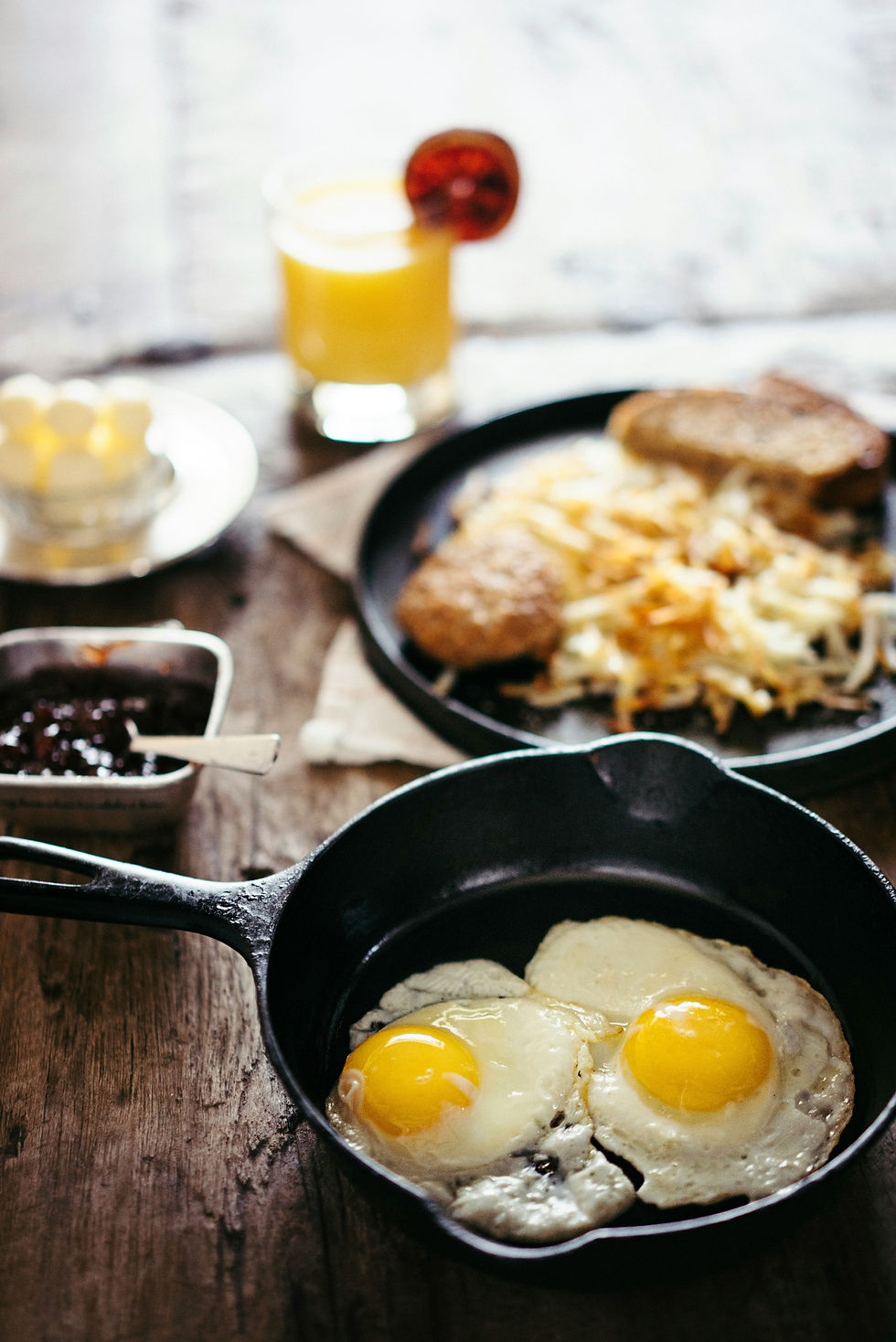
The process of cooking an egg isn’t only delicious but is highly scientific as well. A key to understanding this process? Proteins. Proteins are a complex molecule which are composed of amino acids. Each of the amino acids possess a unique characteristic, and together, they combine to form a complex, unique protein which does various functions. There are two main processes that contribute to cooking an egg. That is denaturation and coagulation. In denaturation, the heat from the pan contributes to the enzymes denaturing or, simply, having their structures unfold, shrink, and break apart. As the amino acids break apart from one another, they will see to find other amino acids to form bonds with. This is when coagulation comes in. Coagulation causes the unfolded proteins to bond together, forming a type of gel. However, this entire process is not always reliant on heat. Denaturation of proteins in eggs may occur due to mechanical actions (such as whipping or beating) or due to an acidic ph (like adding lemon juice). Furthermore, depending on the method the egg is cooked, there might be additional things that the egg will do or go through depending on the way it was cooked. An example of this is scrambled eggs. Scrambled eggs go through “syneresis,” or simply “weep out,” due to the way they’re cooked (syneresis is that watery layer that separates itself in things like sour cream and yogurt). Thus, the method of cooking your egg plays a major role of its “metamorphosis” from uncooked to cooked.
Book III: The Mastery of the Cooking Techniques
There are many popular ways of cooking an egg. You can have eggs poached, soft-boiled, fried, hard-boiled, scrambled, meringues, or souffles. All of these ways are correct ways of serving eggs, and the science between each technique is very intriguing as well!
Poached
To get a perfectly poached egg, it requires a lot of technique and, (not) surprisingly, science to unlock the key to the perfect-poached-egg kingdom. The number one rule is to start fresh. The fresher the egg, the tighter the egg white (after all, as eggs age, moisture and carbon dioxide escape which raises the pH of the egg white--thus making it more watery and thin) Throughout your journey to gain the most perfect poached-egg, you may encounter vinegar (or lemon juice) which will soon become your friend. You will use them as your acid to lower the pH of your poaching water (thus, helping the proteins of the egg coagulate faster). After adding a table spoon of this acid per quart of water, aim for 82 Celsius temperature for your egg. Now, the key to your egg’s metamorphosis is using a lightly oiled ladle, which you will use to crack the egg’s shell and then gently lower it into the water. And then VOILA! You just achieved a scientifically perfectly poached-egg in your own kitchen. Be sure to give yourself a pat on the back.
Soft-boiled
Many scientist have tried to achieve the perfectly soft-boiled egg. In fact, scientists in Italy had developed a new “periodic cooking” method that produces the perfect boiled egg. Using computational fluid dynamics, the researchers created a technique where the egg is moved every two minutes between boiling water (100 Celsius) and warm water (30 Celsius) for about 30 minutes. This frequent temperature switching keeps the yolk at a consistent temperature, thus creating the ideal, soft, runny center. However, unlike the scientists, you probably don’t have 30 minutes to cook a soft-boiled egg (I mean, most of us have like 32 kids to feed, amirite?) So how does one cook a perfectly soft-boiled egg without computational dynamics? The key is the keeping the egg between the 61 to 65 Celsius, which enables the white to set while letting the yolk be liquid. If you have it over 65 degrees, the yolk will harden. Below 61, and the egg white will not set. How would one achieve this perfect window? Through Sous-Vide cooking, which holds the egg at exactly 63-65 Celsius. Sous-vide cooking involves vacuum-sealing the good, which helps to remove the air and retain moisture during cooking. It also allows you to set the water to be a specific temperature, but at a cost of longer cooking time. However, many people do not have the right equipment for sous-vide, thus, it is recommend that you start with room-temperature eggs, and boil the eggs for 4-6 minutes when the water reaches a gentle boil. After boiling, put the eggs into ice water.
Fried
As we all know, eggs (especially the whites) are mostly proteins. In the process of frying an

egg, the proteins play a key role. When an egg hits a hot pan, the proteins in the whites and the yolk denature and coagulate, giving the egg structure. The Maillard reaction (a chemical reaction between amino acids and reducing sugars which occurs when food is heated and leads to browning and development of complex flavors) occurs and creates the fried egg’s characteristic golden-brown color and savory flavor. Heat control is essential in this process. Too low, and the egg is becomes rubbery and pale. If the heat is too high, well, you risk burning it! The perfect stove temperature is putting the egg over medium-high heat to allow the moisture to evaporate quickly and give the egg that crisp edge. Furthermore, it allows the yolk to be runny while the whites set properly.
Hard-boiled
Similar to soft-boiled eggs, hard-boiled eggs also follow a similar process. However, instead of cooking from 4-6 minutes, it is recommended that you cook for 9-12 minutes instead. Furthermore, you can also turn the temperature up to be closer to 70 degrees and not worry about the 4 degree window unlike in soft-boiled eggs.
Scrambled
Ah, the classic scrambled eggs. The egg whites, once again, are the magic behind the flavor and fluffiness of them. As you apply pressure and denature the proteins, different temperature will cause your scrambled eggs to look different. For example, if you start slow and low (60 to 70 degrees Celsius) you will promote even denaturation between the yolk and whites, thus creating a soft, almost custard-like texture (an ideal runny scrambled eggs). Now, if you hit the sweet spot (70 to 80 degrees Celsius) you achieve the golden zone which creates a fluffy texture due to proteins denaturing at a faster rate and air bubble being trapped in the eggs (thus, creating that light, airy texture). Throughout the process, you need to ensure that you have consistent stirring that ensures even cooking and prevents overcooking. However, if you prefer your scrambled eggs tougher or rubbery, you will need to cook at 80 Celsius to achieve a drier scramble. However, there are stuff beyond the temperature which plays a role too. The amount of butter or oil on the pan plays a role because it prevents the eggs from sticking to the pan and adds richness. However, too much butter or oil can make the scrambled eggs greasy. The second item which plays a major role outside of temperature is whisking. Regular whisking breaks up larger protein clumps and incorporates air, which results in a lighter and fluffier texture. Depending on how little or a lot you whisk, it will make your eggs less or more airy. The last item outside of temperature is also the “finish;” once the eggs are almost cooked, you should remove them from the heat to prevent them from drying out since the residual heat will continue to cook the eggs. By understanding the science behind protein denaturation, you are able to manipulate heat and technique to take back control of your scrambled egg and create the ultimate-scrambled-egg lifeform the world has yet to see!
Meringues

You cannot talk about food without mentioning dessert, of course. After all, what’s a 3-course meal without one? Dessert like pavlova and lemon meringue pie are made from whipped egg
whites and sugar. Due to whites being made mostly out of water with proteins made of long amino acid chains that fold into compact shapes, the proteins in the whites unfold when whipped due to whipping mechanically denaturing them. Then, the exposed hydrophobic amino acids move to the surface of air bubbles, forming protein nets that help stabilize the foam (which the sugar also helps to stabilize). Furthermore, by adding acids like lemon juice, you can help promote protein unfolding and prevent over-tightening of protein networks. Additionally, to properly create a meringue, one needs to make sure to avoid fat at all possible because they destabilize the bubbles. More interestingly though, you also need to avoid over-whisking, using copper bowls, and using too much acids because they can cause the meringue to become grainy.
Souffles
Not a fan of meringues? Fine. Why don’t we try a souffle instead. Beating eggs for dishes like soufflés or meringues involves both chemistry and physics. The key first step is separating yolks from whites because yolks contain fat, and even a tiny bit of fat prevents egg whites from forming stable air bubbles. When egg whites are beaten, proteins unfold and create thin skins around air bubbles, trapping air and forming foam—essential for a soufflé’s rise. Furthermore, the bowl where the white will be beat must be spotless and the beating steady and even to incorporate the right amount of air without overwhipping. After being whipped, the whites must be handled quickly and gently due to their delicate structure. Once the whites are folded with the yolks and baked, the trapped air expands in the heat, and the egg proteins set to form that makes a souffle rise and then… BAM! You got yourself a souffle.

Book IV: The Epilogue
No matter how you liked your eggs cooked, one cannot deny that science is a core similarity that they all share. Whenever you realized it or not, doing something like cooking an egg holds a great amount of chemical reactions and even pertains to physics. So, whenever you crack an egg, whip up a souffle, or heat up an egg or a pan, remember the large amount of reactions which are simply happening. Science is everywhere. So stay curious in the daily magic that is happening around you.
Sources:
Want more magical science? Be sure to check out other STEM·E content!


A movie is the finished product Check this that is watched for entertainment, while cinema can refer to the art form itself, the place where movies are shown, or the film industry as a whole. For example, you watch a movie at the cinema. The term "movie" is more colloquial, especially in the US, whereas "cinema" is often used in British English to refer to a movie theater.